
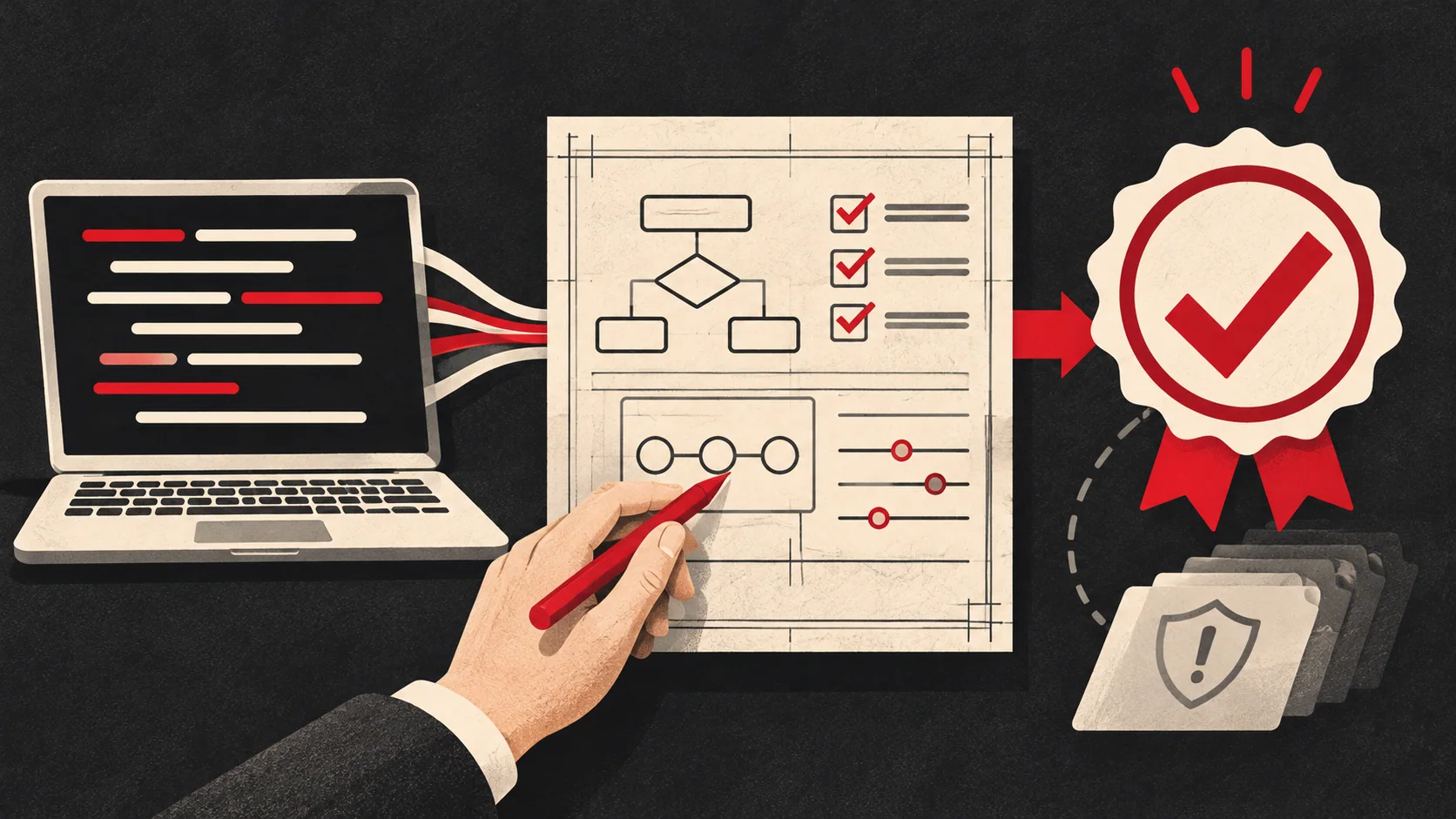
When passing tests does not mean the software is right
You commission a customer portal. Your supplier uses AI to write the software and reports that every test passes. That sounds reassuring, but one question remains: did those tests check what your business actually asked for?
If the same AI writes the code and the tests, it can make the same wrong assumption twice. A portal might pass its checks while letting staff see customer records they should not access. The checks could faithfully confirm the wrong rules.
That is the business problem behind AI-generated code verification. You need evidence that the software follows your agreed requirements, alongside evidence that it runs.
Microsoft Research has shown one way to strengthen that evidence. Its work is still a research prototype, but it gives you useful questions to ask your next software supplier today.
What Microsoft Research showed
On November 5, 2026, Microsoft Research published Formally verifying agent-written full-stack web apps with PDD Kit. Built with GitHub Next, PDD Kit is a toolkit for Proof-Driven Development.
The problem it addresses is scale. Coding agents can generate whole features containing tens of thousands of lines. Reading every line becomes difficult, and an agent can drift from the plan before writing tests that confirm its own interpretation.
PDD Kit helps a team turn plain-language intent into a formal specification: a precise statement of how the software must behave. It uses Verus, a proof language for Rust, to prove that the code meets that specification for every input within the proof’s scope. Where proof cannot reach, it uses tests. Results are labelled as proof or test evidence.
Think of a test as trying particular examples. A proof establishes that a stated rule holds for every possible input covered by that rule. The distinction matters, but so does the rule itself: proving the wrong requirement does not make it right for your business.
The Pet Store example
The demonstration used Pet Store, a full-stack web app with about 5,000 lines of Rust. The researchers formally verified its login logic. Verus hardened the code and uncovered existing bugs, establishing that there were no login bugs relative to the approved specification.
That last qualification matters. This was a claim about specified login behaviour, not a promise that the entire application was flawless.
The developer reviewed the intent without reading the generated code line by line. Inside Chopin, GitHub Next’s shared planning environment, the team reviewed intent, answered decision questions, approved the specification and signed off on components that would be trusted rather than proven.
Why this matters before you can buy it
The demonstration concerns specified Rust behavior verified with Verus. It is not evidence that every application or programming language receives the same assurance.
Its wider value is the direction it points toward: verification becoming part of how serious teams ship AI-built software. This demonstration does not establish how widely teams use it. It shows a way to demand clearer evidence when AI produces more code than people can reasonably inspect.
You do not need to request mathematical proofs for every booking form or invoice workflow. You can ask a supplier to explain what they checked, which requirements guided those checks, and where uncertainty remains.
Six questions to ask your software supplier
Use these in a proposal meeting or before accepting a finished project. Ask for examples from your own project, so the answers stay concrete.
1. Can you show me the written requirements the code was checked against?
Ask for a document you can understand. For a customer portal, it might say which records each role can view, who can change them and what happens when access is refused.
“Secure customer portal” leaves too much open to interpretation. A useful requirement describes an outcome you can recognise. Ask the supplier to connect each important requirement to its checks.
2. Who approved those requirements, and which decisions still need my input?
Someone who understands your business must confirm the rules. Your developer can explain the technical choices, but they should not silently decide whether a receptionist can export every customer’s details.
Name an approver and record unresolved questions before accepting the work. Our article on Designing human oversight into automation explores this responsibility. Approval should happen where a business decision is made, while you can still change it.
3. How do you check the code beyond the AI’s own tests?
Ask who reviews the requirements and test cases, and how the team challenges the AI’s assumptions. Request examples of checks for denied access, missing information and failed operations, where relevant to your workflow.
A useful answer describes a process and shows evidence. “We use AI to review the AI” still needs an explanation of how someone checks that both are working from the right requirements.
4. Which parts are proven, tested or trusted?
Ask for a simple list of the important parts of your system and the evidence supporting each one. If a supplier claims formal verification, ask exactly which behaviour it covers and what it assumes about other components.
PDD Kit makes this boundary explicit. Parts such as bcrypt password hashing, database queries and JWT token signing sit outside its proof and are trusted or tested instead. Together, the trusted pieces form what researchers call the trusted computing base.
For your purchasing decision, the useful question is plain: what must we assume works correctly for this assurance to hold?
5. What happens when the tests and the requirements disagree?
Ask the supplier to walk through an example. Suppose a test passes because any employee can approve a refund, but your requirement allows only a manager to do so.
The team should investigate the mismatch against the approved requirement. If the business rule needs changing, its owner should approve that change. Quietly rewriting the requirement to match the software removes the protection you thought you had.
6. What evidence will you hand over when the work is finished?
Request the approved requirements, a summary of checks and results, known gaps, and the person responsible for resolving them. Agree how changes will be checked after launch, too.
This gives you something concrete to review before accepting the work. It also helps a future supplier understand which promises the software is meant to keep.
What this does not mean
AI-built software is not automatically verified. Passing tests and mathematical proof offer different kinds of evidence, and neither can recover a business requirement nobody wrote down.
Even a proof depends on its specification and trusted components. Approving the right specification remains a human job.
You also do not need to wait for perfect tools. Match the depth of checking to what could go wrong in your workflow. Make the requirements and evidence part of the buying conversation now. “The AI wrote it and the tests pass” is no longer a complete answer.
Choose a useful project and agree how to check it
Start with a workflow you understand, define the result you need and agree how you will judge success. How to choose your first AI automation can help you choose that starting point.
Take the free AI opportunity assessment for a preliminary starting point, or discuss your workflow with GGTAMOL.
Questions business owners ask
Does formal verification mean software has no bugs?
It establishes specified properties within the proof’s assumptions and scope. Requirements, external components, interfaces and deployment still need appropriate review and testing.
Should every small business demand formal proofs?
Match the evidence to the consequences of an error. Clear acceptance tests and permission checks are a useful starting point; ask for stronger assurance around critical behavior.
What should I receive before accepting AI-built software?
Request approved requirements, test results, any proof scope and trusted assumptions, known issues, rollback steps and a named owner for unresolved work.